The Analog Renaissance: Why Top Performers Are Returning to Paper Planners
Share
In a world dominated by task management apps, digital calendars, and endless push notifications, a surprising trend is emerging among Silicon Valley executives and high-achievers: a return to physical paper. The analog renaissance is not driven by nostalgia; it is a calculated response to the overwhelming digital fatigue that defines modern knowledge work.
When your entire workday—from team meetings to strategic execution—happens on a single glass screen, the boundaries between different tasks dissolve. Switching from a complex spreadsheet to a digital calendar feels identical to the brain, leading to severe context-switching exhaustion. Stepping away from the screen to manage your time offers a profound cognitive reset.
Neuroscience provides a compelling argument for picking up a pen. The physical act of handwriting engages the brain's Reticular Activating System (RAS), which acts as a filter for what your brain processes and remembers. When you physically write down a goal or a daily priority in a premium notebook, your brain tags it as highly important. This tactile process significantly increases memory retention and the likelihood of execution compared to effortlessly typing a note on a keyboard.
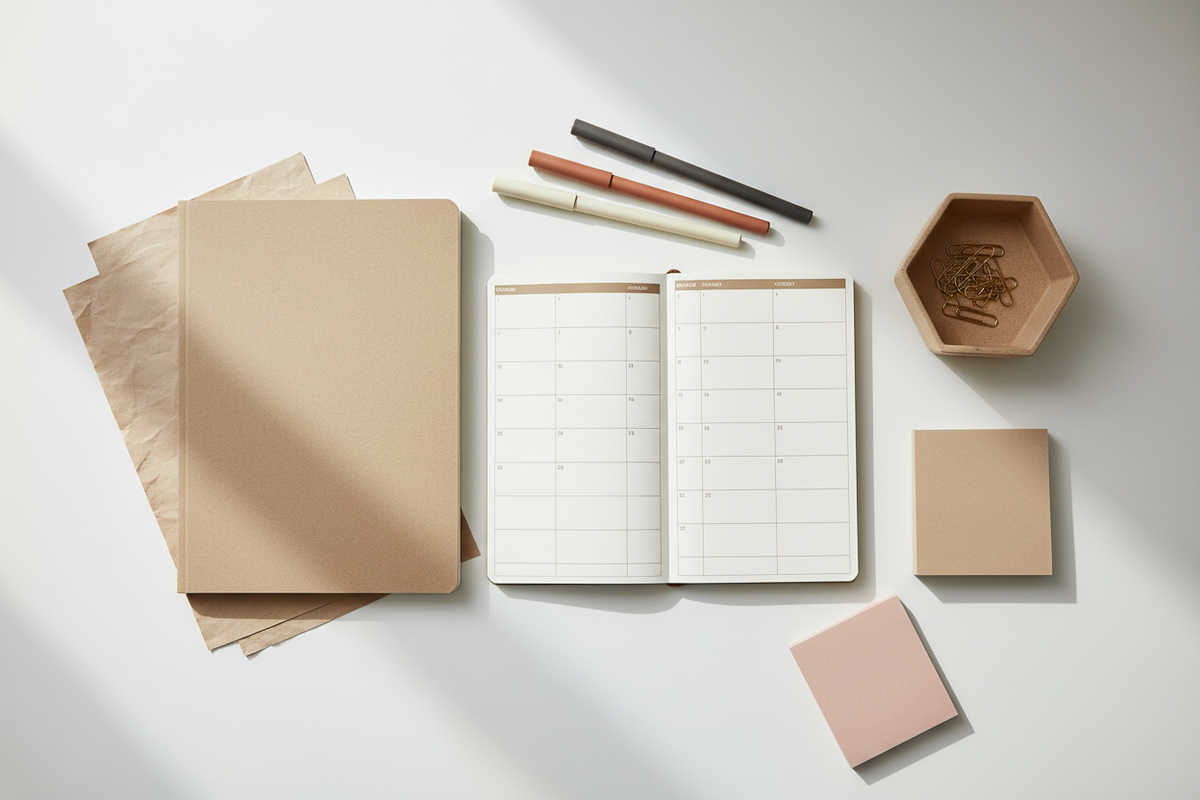
To build a highly effective hybrid system, use digital tools for storage and scheduling, but reserve analog tools for action and deep focus. Utilize a physical bullet journal or a weekly desk pad to map out your top three daily priorities. Keep this planner open on your desk directly below your monitor as a constant visual anchor. When paired with a heavy, smooth-gliding premium pen, the simple act of crossing off a completed task becomes a deeply satisfying ritual that digital checkmarks simply cannot replicate.